
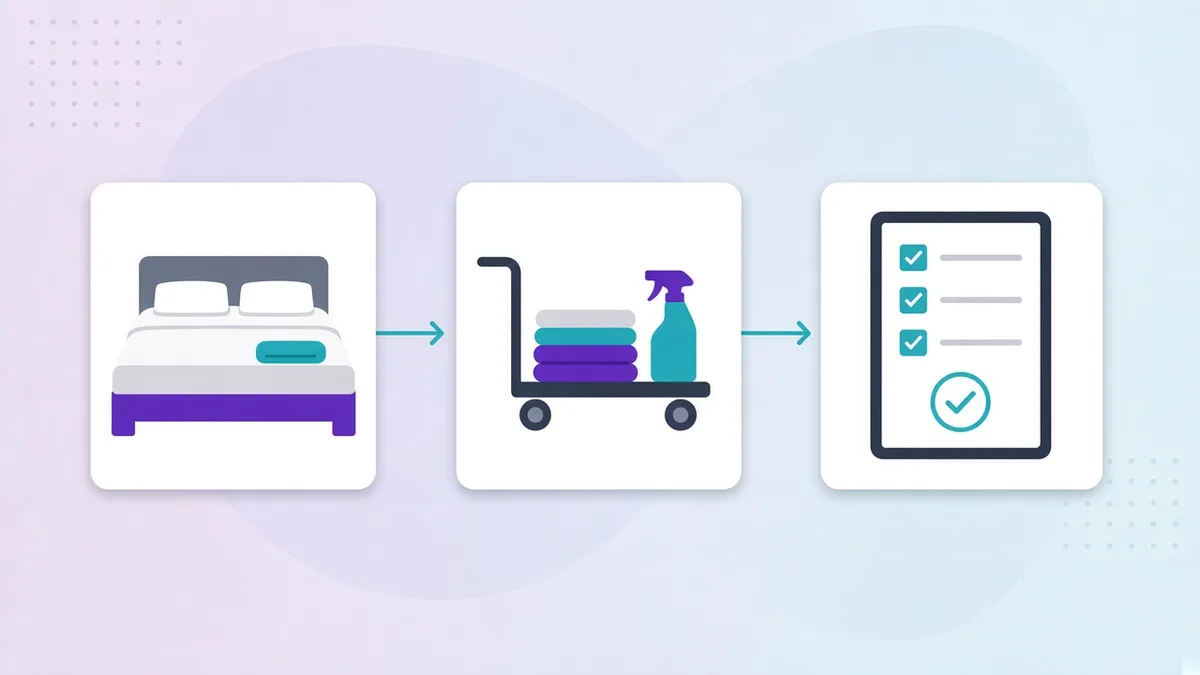
A guest does not see the hotel’s housekeeping procedures. They see whether the glass has a watermark, whether the hair is gone from the shower drain, whether the bed looks like the photo. Housekeeping is the department where standards are most visible to guests and least visible to management, because by the time a manager inspects a room, the attendant who cleaned it is three rooms away.
Standard operating procedures are how a housekeeping department of sixty attendants across two or three properties produces the same room every time, and how the executive housekeeper proves it. Here are the SOPs that matter, the standard for each, and the proof each should leave. For the writing method see how to write an SOP; for definitions, our guide to standard operating procedures.
1. Shift start, assignment and trolley setup
Covers: briefing, room assignments and priorities (departures first, VIPs, early arrivals, out-of-order rooms), trolley stocked to par (linen, amenities, chemicals, supplies), key or device issue, PPE.
Standard: every trolley stocked to the par photo before the first room; assignments acknowledged; keys signed out.
Proof: trolley photo against standard; assignment acknowledgement; key log.
2. Guest room cleaning sequence
Covers: the fixed order: knock and announce, enter and ventilate, strip and remove waste, check for maintenance issues and lost property, bathroom, dusting high to low, bed making, floors, final walk-through from the door.
Standard: the sequence is followed in order every time (it exists to prevent re-contamination: bathroom before bed, dust before vacuum); time standard per room type (commonly 25–30 minutes for a departure, less for a stayover) as a target, not a stopwatch.
Proof: room completion timestamps; any maintenance issue or lost property raised from within the room task with a photo.
The sequence is the master SOP of housekeeping. Attendants trained on the sequence produce consistent rooms; attendants trained on a list of things to clean do not.
3. Bathroom standard
Covers: chemicals and cloth colour-coding (toilet cloth never touches the basin), descaling, glass and mirrors, grout and silicone, drain hair check, amenities layout, towel fold and placement, toilet seal.
Standard: a photo standard of the finished bathroom; no water marks on glass or chrome; drains clear; amenities in the defined layout and quantity.
Proof: supervisor inspection of a sample of rooms with photo on any fail; colour-coding checked during trolley setup.
4. Bed making and linen
Covers: linen inspection for stains and damage, bed-making method to the brand standard, pillow and cushion layout, linen change frequency for stayovers, soiled linen handling, linen par and counts.
Standard: a photo standard of the finished bed; stained or damaged linen rejected and tagged; stayover linen changed on the brand schedule or on request.
Proof: bed photo on inspection; rejected linen count per shift; linen room counts weekly.
5. Amenities, minibar and in-room items
Covers: amenity set per room type, replenishment rules for stayovers, minibar check and restock (or confirmation of no minibar), in-room collateral and stationery, electronics check (TV, remote, safe open and reset, lights, AC).
Standard: amenity set complete to the photo; safe left open and reset on departure clean; every light and the TV checked working.
Proof: item-level checklist for departures; minibar consumption posted before the guest checks out.
6. Room inspection and release
Covers: who inspects which rooms (all departures and a sample of stayovers is common), the inspection form and scoring, how fails are fixed and re-inspected, release to front office as vacant-clean.
Standard: no departure room released without inspection; defined pass threshold; fails corrected before release.
Proof: scored inspection per room with photos on fails; release timestamp. This is the step that turns housekeeping from effort into verified quality; in Opscale it runs through inspections with results by attendant and floor.
7. Turndown service
Covers: which rooms and when, the turndown set (bed, lighting, curtains, amenities, collateral), handling do-not-disturb, time standard.
Standard: a photo standard for the turndown; DND respected and logged.
Proof: completion per room; DND log.
8. Lost and found
Covers: what to do when property is found (bag, tag, log, hand to the lost-and-found custodian within the shift), storage, guest enquiries, retention period, disposal or donation.
Standard: every item logged with room, date, finder and description the same shift; stored securely; retained for the defined period.
Proof: lost-and-found log entries with photo. Run it through the logbook so front office and housekeeping share one record.
9. Chemical handling and safety
Covers: approved chemicals and dilutions, dispensing, colour-coded cloths and buckets, PPE, storage, safety data sheets, spill and exposure response, sharps and bodily fluids.
Standard: only approved chemicals at approved dilutions; PPE worn; SDS accessible; incidents reported within the shift.
Proof: dilution check at trolley setup; PPE confirmation; incident reports.
10. Public areas and back of house
Covers: lobby, corridors, lifts, public restrooms, pool and gym areas, staff areas; frequency per area; night cleaning scope.
Standard: public restrooms checked and recorded at set intervals; lobby and lifts to photo standard at defined times; night tasks completed and photographed.
Proof: interval check timestamps; zone photos.
11. Deep cleaning and preventive schedule
Covers: rotating deep-clean programme per room (mattress turning, carpet shampoo, curtain cleaning, high dusting, AC vents, grout), out-of-order coordination with maintenance.
Standard: every room deep-cleaned on the cycle (often quarterly); schedule visible to housekeeping, front office and maintenance.
Proof: per-room deep-clean completion with photos; out-of-order log.
12. Maintenance reporting
Covers: how attendants report faults (dripping tap, loose fixture, AC noise, stained ceiling) with a photo from the room, priority categories, response targets, re-check on completion.
Standard: every fault raised from the room before release; defined response time by category.
Proof: maintenance requests with photos and resolution times via requests and approvals.
What is different about housekeeping
- Sequence matters more than list. Train and inspect the order, not just the outcomes.
- Photo standards per room type are the shared language between a multinational team and a brand standard written in English.
- Inspection is part of the SOP, not an afterthought. A room is not clean until it is inspected and released.
- Volume is high and time is short. Keep room-level proof to the inspection, maintenance and lost-property moments; do not ask attendants to photograph every room they clean.
Multi-property and multilingual teams
Hotel housekeeping teams in the Gulf and Lebanon commonly include six or more nationalities. The SOPs that work are short, photo-led and available in the two languages the team shares, with the sequence video attached to the task. Our guide to bilingual Arabic–English SOPs covers the approach.
Across properties, the executive housekeeper needs one standard, one inspection form and one view. In Opscale, standards and sequence videos live in the operations library; daily assignments, public-area intervals and deep-clean cycles run as role-based tasks in tasks and checklists; room inspections and scores in inspections; lost and found and incidents in the logbook; and the executive dashboard shows inspection pass rates and completion by property, floor and attendant. The AI checklist creator will draft any of these from your brand standards document. More on how hotels in the region use it on our hospitality page.
The guest sees the room. The SOP is how the room comes out the same on the days nobody is watching.