
Writing an SOP is the easy half. The hard half is getting forty people across six branches, half of whom joined in the last year, to perform it the same way on a busy Thursday with nobody watching, and then being able to prove that they did.
Traditional training does not solve this. A classroom session on day one, a binder to read, a quiz, and a signature on a training record produce exactly one thing: a training record. Six weeks later the procedure is done from memory and habit, and the habit is whatever the person next to them does.
This article covers what works instead: training in the flow of work, proof on the steps that matter, assignment by role, and a short weekly review of three numbers. It assumes you already have SOPs worth training on; if not, start with how to write an SOP and the SOP template.
Why SOP training fails in multi-site businesses
Four reasons come up every time:
Turnover. Frontline turnover in Gulf hospitality and retail commonly exceeds 50% a year. Anything that depends on a one-time induction is retraining itself constantly and losing.
Distance. Head office trains the branch manager, who trains the supervisor, who shows the new hire. By the third hop the procedure has changed.
Language. A team of eight nationalities does not share one language of instruction. A manual in English trains the people who read English well. Our guide to bilingual SOPs covers this in depth.
Timing. The procedure is taught on a Tuesday morning and first needed on a Saturday night. The gap is where it is forgotten.
Fix the timing and you fix most of the rest.
Principle 1: Train in the flow of work
The most effective moment to teach a procedure is the moment someone is about to do it. That means the instruction has to live inside the task:
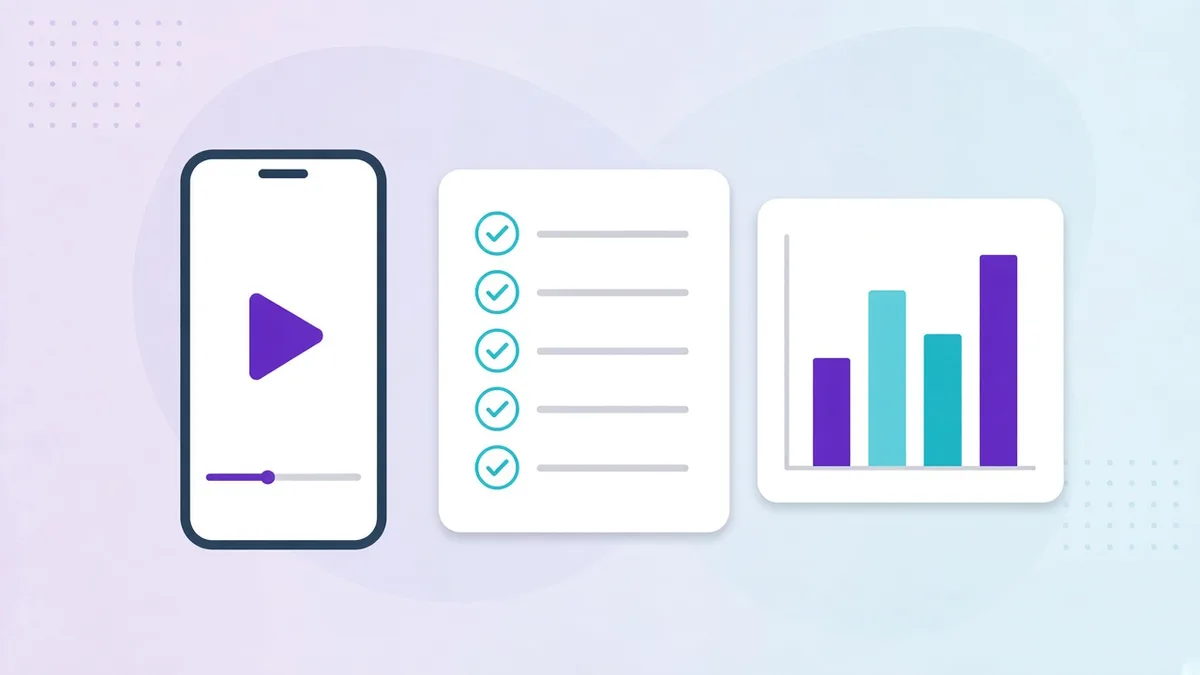
- The closing task on the phone has a “How to” link that opens the SOP, in the team member’s language, with photos.
- The espresso machine cleaning step has a 90-second video attached, filmed on your own machine.
- The receiving task shows the acceptable temperature range next to the field, so nobody has to remember it.
A new hire can then perform any routine on their first shift, correctly, without a manager standing over them, and the training happens every time they do it until they do not need it. In Opscale the SOP document and its video live in the operations library and are linked from the task in tasks and checklists.
Principle 2: Make the video, not the manual
A procedure manual is read once, under duress. A 60 to 120 second video of your best operator doing the task on your equipment is watched repeatedly, needs almost no reading ability and survives language barriers better than text.
Rules for useful SOP videos:
- Film on a phone, in your own kitchen or store, with the real equipment. Production quality is irrelevant; recognisability is everything.
- One procedure per video. Under two minutes. If it is longer, split it.
- Show the standard: what “clean” looks like at the end, where the thermometer goes, how the shelf is faced.
- Subtitle in the two languages your team shares.
- Re-film when the procedure or equipment changes. An out-of-date video trains the wrong thing with great confidence.
Principle 3: Proof on the steps that matter
Training tells you people know the procedure. Proof tells you they did it. For each SOP, decide which steps are critical and what evidence they leave:
| Step type | Proof | Why |
|---|---|---|
| Measurement (temperature, ppm, count) | Numeric field with a valid range | Out-of-range values are flagged instantly; patterns are visible over time |
| End state (cleaned, faced, locked) | Photo | Hard to fake; coaches by example when reviewed |
| Handover or cash | Signature from both parties | Two-person accountability |
| Everything | Automatic timestamp and user | Shows when it was really done, not when the sheet was filled in |
Do not ask for proof on every step. Five photos per closing is reviewed; thirty is ignored. The pattern a reviewer should be able to see is: this person, at this time, hit this standard, and here is the evidence for the parts that carry risk.
Principle 4: Assign by role, not by person
“Fatima does the opening checks” is a training plan that resigns when Fatima does. Assign each SOP to a role and a shift: whoever is scheduled as opener at the Olaya branch gets the opening routine at 06:30. The new opener inherits the exact same routine, instructions and standards as the last one, with no handover meeting.
This also makes compliance comparable. Completion rates for “opener, Riyadh branches” mean something; completion rates for a list of names do not.
Principle 5: Inspect what you expect
Checklists tell you what staff reported. Inspections tell you whether the report matches the floor. A short, scored inspection, carried out by a supervisor or area manager on a schedule, using the same form at every branch, closes the loop:
- Same questions, same scoring, every branch, so results are comparable
- Photos required on failed items, so the inspection coaches as well as scores
- Follow-up tasks generated automatically from failed items, assigned to the branch
Where checklist completion is high but inspection scores are low, you have a training problem. Where both are low, you have a management problem. Where both are high, leave that branch alone and go help the others. Opscale’s inspections module runs this; our note on operational KPIs for multi-site managers has more on reading the numbers.
The three numbers that prove compliance
You do not need a dashboard of forty metrics. Three, per branch, per week:
- On-time completion rate. Of the scheduled SOP tasks, what share were completed within their window? Below 90% means the routine is not yet a habit or the staffing does not allow it.
- Exception rate. How many steps were out of range or failed, and were corrective actions logged? A branch with zero exceptions for a month is either perfect or pencil-whipping. Both deserve a visit.
- Inspection score. The independent check. Trend it against the first two.
Review them in a 15-minute weekly call with branch managers. Praise the top, ask about the bottom, and pick one SOP per branch to coach that week. This is the entire compliance programme for most groups under fifty sites.
Proving it to someone else
Sooner or later a food-safety inspector, a franchisor, a mall operator, an insurer or a buyer in a due-diligence process will ask you to prove your procedures are followed. With paper, the answer is a day of photocopying and a prayer. With a digital system, the answer is:
- The current SOP, with version history, from the library
- The training record: who has watched or acknowledged which version, by role
- The execution record: every completion, reading, photo and corrective action for any branch and period, searchable
- The inspection history and follow-ups
Operators in Saudi Arabia and the UAE increasingly need exactly this for regulatory visits; see our guides to food safety SOPs in Saudi Arabia and in the UAE.
A 30-day plan
- Week 1. Pick three SOPs that matter most. Put them in a library with a one-minute video each. Link them from the corresponding tasks. Assign the tasks by role and shift.
- Week 2. Require proof on the critical steps. Tell the team why: not surveillance, but protection when something goes wrong.
- Week 3. Run the first inspection round with a single shared form.
- Week 4. Hold the first 15-minute review on the three numbers. Pick one coaching target per branch.
Then add the next three SOPs. In a quarter you will have a dozen procedures genuinely followed, a training approach that survives turnover, and records that stand up to anyone who asks.