
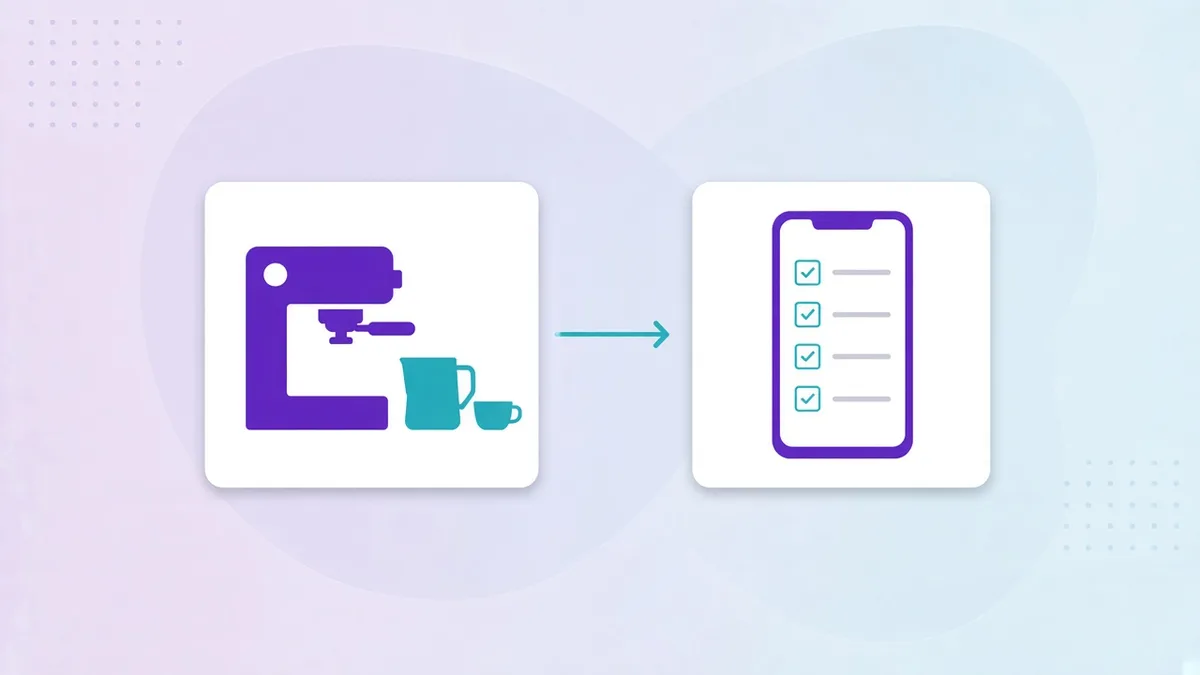
Specialty coffee is a consistency business. Customers who pay a premium for a flat white in Riyadh’s Al Olaya expect the same cup at the branch in Jeddah, and they notice when they do not get it. The variables that decide that cup, grind, dose, yield, time, milk temperature, texture, cleanliness of the group head, are all controllable, and the way to control them across ten cafés and forty baristas is standard operating procedures.
Café SOPs differ from restaurant SOPs in emphasis. Food safety still matters (milk and pastries are high-risk), but the bulk of the procedures are about the drink and the experience. Here are the ones a café chain needs, what the standard is for each, and what proof it should leave. For the general method see how to write an SOP and our SOP guide.
1. Opening and dial-in
Covers: machine on and up to temperature, water filter check, grinder purge, dial-in of each espresso to the day’s recipe, milk fridge temperature, pastry display set, POS and payment terminals up, music and lighting, bathroom check.
Standard: the recipe card for each coffee: dose (e.g. 18 g), yield (e.g. 36 g), time (e.g. 27–30 s), with the acceptable tolerance. Dial-in is logged, not guessed.
Proof: dose, yield and time recorded per grinder at opening; milk fridge reading; photo of the pastry display as set.
Dial-in is the SOP that most directly protects the product. When roast profiles or beans change, the recipe card changes centrally and every branch sees the new numbers at the next opening.
2. Espresso extraction and recipe adherence
Covers: the per-coffee recipe, re-dial triggers (time drift, humidity, new bag), tamping, shot assessment, when to pull a shot again.
Standard: shots within the recipe tolerance; re-dial whenever time drifts outside range; no shot served outside tolerance.
Proof: periodic recipe check during the shift (one logged shot per grinder mid-morning and mid-afternoon is a common rhythm).
3. Milk handling and steaming
Covers: milk storage temperature, rotation and dating of opened cartons, pitcher hygiene, steaming to temperature, texture standard per drink, no re-steaming, alternative milks and cross-contact.
Standard: milk stored at or below 5°C; opened milk discarded per your policy (often 24–48 hours, dated); steamed to 55–65°C depending on the drink; alternative milks in dedicated pitchers.
Proof: fridge readings in the cold-holding log; opened-carton dating checked at opening and closing.
Milk is the café’s biggest food-safety exposure and its biggest taste variable. One SOP covers both.
4. Equipment cleaning: machine, grinders, brewers
Covers: backflushing per group head, steam wand purge and wipe after every use, drip tray and drain, grinder hopper and burrs, batch brewer and urns, blender and ice machine, water filter changes.
Standard: backflush with cleaner at closing (and water backflush mid-shift); steam wand purged and wiped after every drink; grinder hoppers emptied and cleaned per schedule; filter changed on the meter or date.
Proof: completion per item; photo of the drip tray and group heads at closing; filter change date logged in the equipment record.
Equipment cleaning is where café consistency is won or lost over months. A dirty group head changes the cup more than a slightly off dose.
5. Brewed coffee and cold brew
Covers: batch brew recipe and hold time, discard time, cold brew steeping and storage, labelling of batches.
Standard: batch brew discarded after a defined hold time (often 60–90 minutes); cold brew dated and used within a set period and stored at or below 5°C.
Proof: batch start time and discard time logged; cold brew batch labels photographed.
6. Pastry and food display
Covers: display temperature where chilled, allergen labelling, rotation, display standard (how items are presented, how many, when to replenish), end-of-day handling.
Standard: chilled display at or below 5°C; every item labelled with name and allergens; display replenished to the standard photo.
Proof: display temperature reading in the cold-holding log; photo of the display at opening and after the lunch replenish; waste count at closing (which also feeds your food-waste programme).
7. Queue, order and service standard
Covers: greeting, order accuracy, name and order call, cup marking, drink time targets, handling peak queues, loyalty and app orders, delivery aggregator pickups, table clearing.
Standard: defined target from order to hand-off (many chains use 3–4 minutes for espresso drinks at peak); greeting within a set time; aggregator orders prepared on a defined priority rule.
Proof: this is the one SOP where proof is mostly observational: a weekly scored service inspection by the manager or area manager, plus mystery visits.
8. Cash, till and tips
Covers: float, drops, voids, refunds, mobile payment reconciliation, tip handling and distribution policy.
Standard: two-person counts at open and close; variance tolerance; voids above a threshold approved by a shift lead.
Proof: signed counts; variance log; end-of-day report photographed.
9. Closing
Covers: full machine clean and backflush, grinders emptied, milk fridge check and discard of expired opened cartons, display cleared and recorded, pastry waste counted, surfaces and floor, bins, cash close, back door and alarm.
Standard: machine cleaned to the photo standard; no opened milk past its date left in the fridge; waste recorded.
Proof: photos of group heads and steam wands, milk fridge reading, waste count, back door photo, cash close signatures. Our opening and closing checklist template adapts easily to a café.
10. Barista onboarding and recipe changes
Covers: how a new barista is trained to the recipe and texture standard, how competency is signed off, how recipe or menu changes are communicated and confirmed.
Standard: no barista on the machine solo before sign-off; every recipe change acknowledged by every barista at every branch before the switch date.
Proof: sign-off record per barista per skill; acknowledgement of each recipe-card version. In Opscale the recipe cards, videos and sign-offs live in the operations library, and acknowledgements are tracked per role.
What is different about cafés
- The recipe is a standard. Treat dose, yield and time like temperatures in a restaurant: numbers, tolerances, logged.
- Cleaning is quality, not just hygiene. Make it visible with photos.
- Peaks are brutal and short. SOPs should be fast to complete; a closing with forty photos will not be done at 23:00 after a 14-hour day. Pick the five photos that matter.
- Turnover is high. Role-based assignment and in-task training videos matter more than classroom sessions; see how to train staff on SOPs.
Rolling out across branches
Put the recipe cards and SOPs in one library with videos filmed on your own machines. Build opening, closing, cleaning and cold-holding as scheduled tasks assigned to the opener, closer and shift lead roles at every café. Run a weekly scored service and cleanliness inspection with a single form across all branches. Review on-time completion, exceptions and inspection scores by café every week.
In Opscale that is the operations library, tasks and checklists and inspections, with the AI checklist creator drafting each SOP from your current recipe card or paper sheet. More on how coffee chains in the region use it on our coffee shops page.
The cup in Jeddah should taste like the cup in Riyadh. That is a procedure problem, and procedure problems are solvable.