
A restaurant with one branch runs on the owner’s attention. A restaurant with four runs on procedures, or it does not run consistently at all. The question we get most from groups expanding across Beirut, Riyadh, Jeddah and Dubai is not “should we have SOPs” but “which ones, and what should each actually contain”.
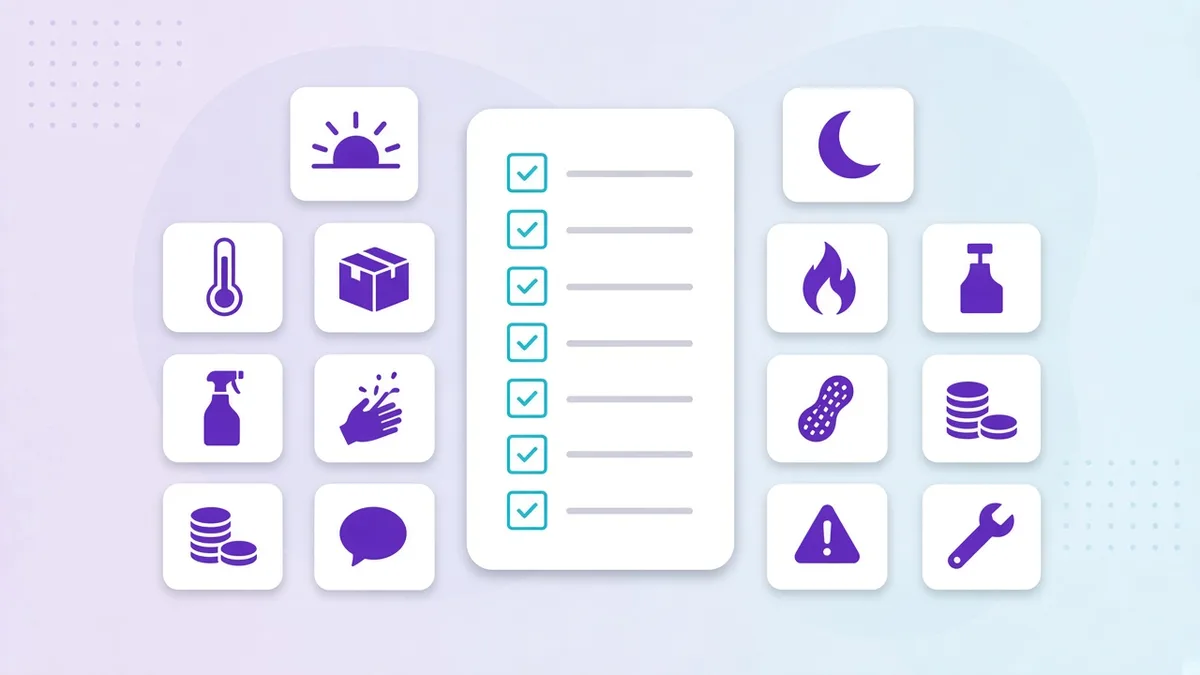
This is the list. Twelve standard operating procedures that cover food safety, money, guests and the building, in the order most groups should write them. For each one: what it covers, the standard that matters most, and the proof it should leave. For the method, see how to write an SOP; for the structure, the SOP template; for the overview, our guide to standard operating procedures.
1. Opening
Covers: unlocking and alarm, lights and equipment on, temperature checks of every refrigeration unit, hand-wash stations stocked, sanitizer made up and tested, prep areas cleaned, front-of-house set, POS float counted, menu and specials confirmed, uniforms and hygiene check.
Standard that matters most: every cold unit read and in range before any food is handled.
Proof: reading per unit, photo of sanitizer test strip, float count with signature, completion time. A full version is in our opening and closing checklist template.
2. Closing
Covers: final temperature readings, food labelled and dated and stored, equipment cleaned and switched off per the cleaning schedule, waste out and bin area clean, floors and surfaces sanitized, cash reconciled and dropped, back door locked, alarm set.
Standard: nothing left out of temperature overnight; cash variance within tolerance; back door photographed locked.
Proof: readings, photos of key end states (bins, back door, panel armed), cash reconciliation signed by two people. Closing is the SOP most often pencil-whipped on paper, which is why photo proof matters most here.
3. Receiving deliveries
Covers: vehicle check, quantity match to delivery note, temperature probe per chilled category, frozen state check, date and label check, accept or reject, storage within a time limit, signed note.
Standard: chilled 0–5°C, frozen solid, use-by at least an agreed number of days away, into storage within 15 minutes.
Proof: reading per category, photo of any rejection and of the signed note. The complete worked SOP is in the template article.
4. Cold-holding and temperature logs
Covers: scheduled readings of every fridge, freezer, walk-in and display unit; corrective action on out-of-range readings.
Standard: chilled at or below 5°C; frozen at or below -18°C; at least four readings a day in most regimes.
Proof: numeric readings with automatic timestamps; photo and corrective action on exceptions. This is the record inspectors ask for first; see digital HACCP logs in Saudi Arabia.
5. Cooking, cooling and hot-holding
Covers: core temperatures for cooked items, cooling times and temperatures before refrigeration, hot-holding temperatures and time limits, reheating.
Standard: core 75°C (or the equivalent time–temperature combination your regime accepts); hot-holding at or above 60°C; cooling from 60°C to 21°C within two hours and to 5°C within a further four is the common benchmark.
Proof: core temperature per batch for high-risk items; hot-holding readings per period; cooling log with start and end times.
6. Cleaning and sanitation schedule
Covers: what is cleaned, how often, with what chemical at what concentration, by whom; daily, weekly and monthly items; deep cleans.
Standard: defined per surface and piece of equipment: “no visible residue, sanitizer at 200 ppm”, not “clean”.
Proof: completion per item, photo of end state on the items that matter (grills, hoods, ice machine, drains), chemical test strip photo.
7. Personal hygiene and fitness to work
Covers: hand-washing frequency and method, uniforms and PPE, hair and jewellery, illness reporting and exclusion, health certificates where required.
Standard: valid health card on file for every food handler where the municipality requires it; no symptomatic staff handling food.
Proof: daily fitness-to-work confirmation per team member, health certificate expiry tracked in the staff record. Regional specifics are in our UAE and Saudi food safety SOP guides.
8. Allergen handling
Covers: the allergen matrix for every menu item, how guests’ allergen questions are answered, separation during prep and service, labelling, what to do on an allergen incident.
Standard: one source of truth for allergens, posted and in the app; a defined response script; separate equipment or cleaning between allergen and non-allergen prep.
Proof: matrix version acknowledged by all front-of-house staff; incident reports in the logbook.
9. Cash handling and end-of-day
Covers: float counts, drops during service, voids and refunds authorisation, end-of-day reconciliation, safe procedure, banking.
Standard: two-person counts and signatures at open and close; variance tolerance defined; voids above a threshold approved by a manager.
Proof: signed counts, variance logged with explanation, photo of the reconciliation report.
10. Guest complaints and refunds
Covers: how a complaint is received, who can offer what remedy, when to escalate, how it is recorded, follow-up.
Standard: every complaint logged the same day with category and remedy; defined authority levels for comps and refunds.
Proof: complaint entry in the logbook with time, category, remedy and staff member; weekly review of patterns by branch.
11. Incident reporting
Covers: injuries, food-safety incidents, equipment failures, security events, near misses; who is informed and within what time; what is recorded.
Standard: report within the shift; photos where relevant; manager acknowledgement.
Proof: structured incident entry with timestamp, photos and follow-up actions. Opscale’s logbook exists for exactly this and for complaints.
12. Equipment maintenance and pest control
Covers: preventive checks (filters, seals, calibration), contractor visits, pest-control schedule and findings, breakdown reporting.
Standard: thermometer calibration weekly; refrigeration service and pest control on schedule with reports filed.
Proof: calibration log, contractor report photos, breakdown request with resolution time. Maintenance requests run through requests and approvals in Opscale.
How the twelve connect
Written down like this, the twelve look like twelve documents. In a working operation they are a system:
- Opening and closing are the backbone; most other SOPs plug steps into them (the morning temperature readings are the cold-holding SOP executing inside the opening routine).
- Receiving, cold-holding, cooking and cleaning together form your HACCP-based food-safety system, which is what regulators in the Gulf want to see as procedures plus records.
- Hygiene and allergens are the people-facing side of food safety.
- Cash, complaints and incidents protect money and reputation and generate the logbook that tells you what is really happening.
- Maintenance keeps the equipment that all the other standards depend on within range.
Making them run in every branch
Three decisions turn the list into a working set of procedures:
- Assign by role and time, not by person. The opener at every branch gets the opening SOP at 06:30; whoever receives a delivery gets the receiving SOP when the truck arrives.
- Capture proof on the critical steps only. Readings, a handful of photos, two signatures a day. Enough to defend, not so much it is ignored.
- Review three numbers weekly per branch: on-time completion, exceptions and inspection score. See how to train staff on SOPs and prove compliance.
In Opscale, these twelve are a library of SOPs with training clips in the operations library, scheduled tasks with validation and proof in tasks and checklists, complaint and incident records in the logbook, scored branch visits in inspections and a per-branch view in the executive dashboard. The AI checklist creator will draft any of the twelve from a description or your existing paper form.
Start with opening, closing and receiving. The rest follow in a quarter.